Squarespace Architecture | Redirects, Broken Links, and Structural Continuity
A structural guide to preserving navigational integrity within evolving digital ecosystems.
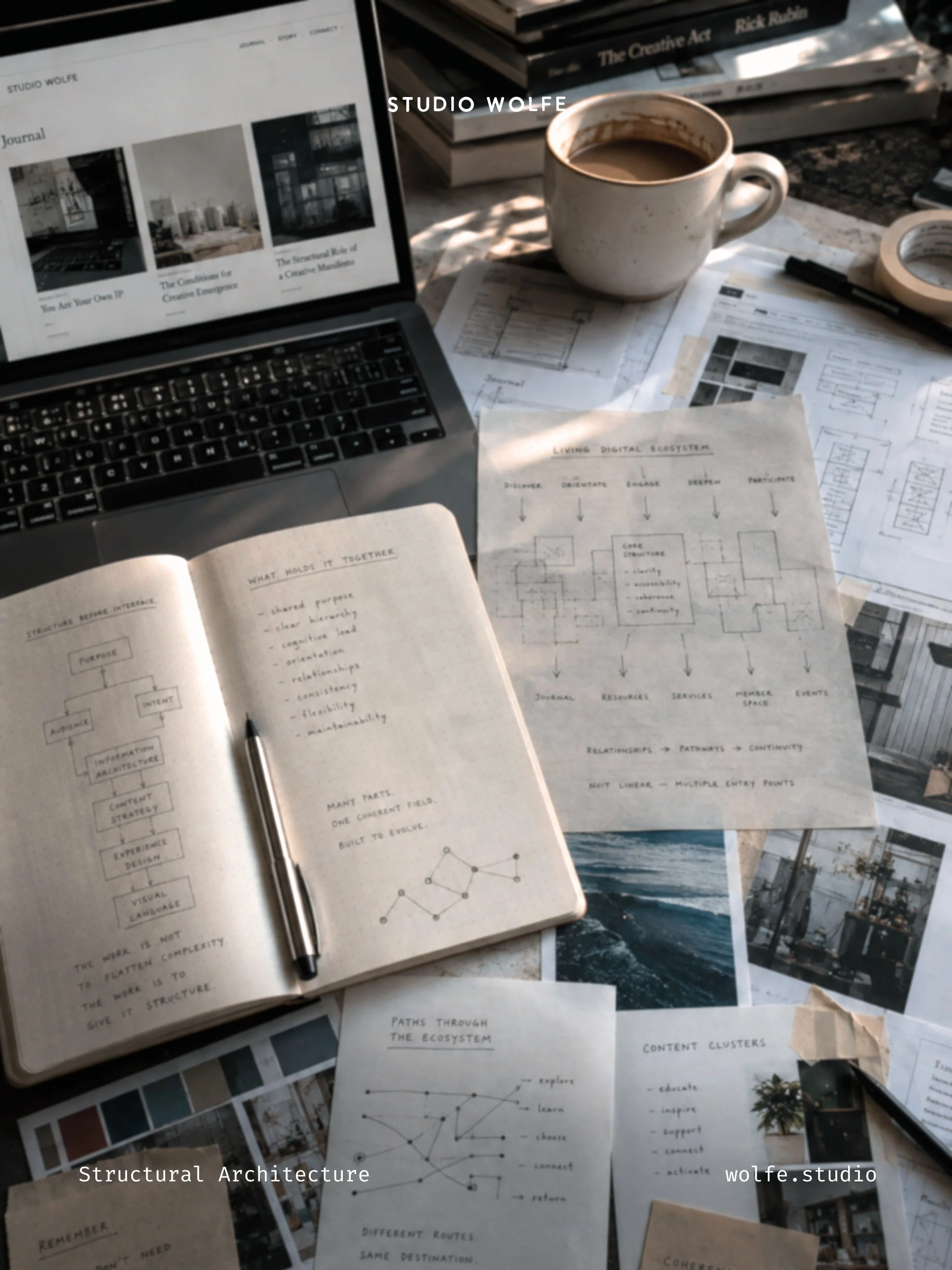

INSIDE THIS FRAMEWORK
Digital Environments Evolve — why websites inevitably change as bodies of work expand.
Structural Continuity — maintaining coherence as pages move, grow, and reorganise.
Broken Pathways — how link degradation quietly fragments digital systems.
Restoring Orientation — the role of thoughtful 404 pages in guiding visitors.
Redirects as Structural Bridges — connecting historical URLs to evolving site structures.
Link Integrity Audits — identifying breaks before they affect visitors or search systems.
Documentation as Architecture — tracking structural relationships across the site.
Long-Term System Stewardship — maintaining reliability as the ecosystem grows.
Structural continuity determines whether evolving websites remain navigable
Digital environments evolve continuously, and their pathways must evolve with them.
As ideas develop, services shift, and bodies of work expand, websites inevitably change. Pages move to new locations, sections are reorganised, and articles accumulate over time. Entire areas of a site may be restructured as the work itself grows and deepens.
These changes are natural. Yet each structural shift quietly alters the pathways that connect one part of the site to another.
Links that once connected ideas may stop working. Pages move without visitors realising, and references to earlier material continue circulating through search engines and external links. Content that once sat within a clear structure can gradually become disconnected from the environment that originally supported it.
Without structural continuity, the digital environment slowly fragments.
Visitors encounter dead ends where pathways once existed. Search systems lose clear routes through the site, and the coherence of the environment begins to erode.
Redirects, link audits, and thoughtfully designed 404 pages exist to prevent this fragmentation. They are often treated as routine technical maintenance, yet in practice they preserve continuity within an evolving digital ecosystem. By maintaining the relationships between pages as a site changes, they allow both visitors and search systems to move through the environment with clarity.
Multidimensional Work Requires Reliable Pathways
Structural continuity becomes especially important when designing websites for creative practices that cannot be reduced to a single linear narrative.
Many multidimensional creative ecosystems operate across multiple domains. Their work may include intersecting areas of expertise, evolving frameworks, and bodies of content that connect across different parts of the site.
Visitors rarely move through these environments in a predictable sequence.
Instead they explore.
An article may lead to a framework.
A framework may connect to a service.
A service may reference earlier thinking.
Links function as the pathways through this landscape. This is why mapping digital ecosystems matters: the site must first be understood as a connected environment before its pathways can be maintained with clarity.
They allow visitors to follow threads of curiosity across the site, discovering connections between ideas that may sit in different sections of the environment.
When those pathways break, the experience collapses.
A visitor following a line of thought suddenly reaches a dead end. Orientation disappears. Trust in the environment begins to weaken.
Maintaining link integrity therefore becomes part of preserving the quality of the visitor journey itself.
When Paths Disappear: The Role of the 404 Page
Even within a carefully maintained website, visitors will occasionally reach a page that no longer exists.
A page may have been removed.
A URL may have changed.
A visitor may follow an outdated link that continues circulating online.
When this happens the server returns a 404 error.
Most default 404 pages provide little guidance. They simply inform the visitor that the page cannot be found, leaving them unsure how to continue navigating the site.
A thoughtfully designed 404 page restores orientation.
Instead of reaching a dead end, the visitor encounters a clear invitation to continue exploring the environment.
Well-designed 404 pages typically include:
A brief explanation that the page cannot be located
Links to key areas of the site
Navigation options or a search field
Visual continuity with the rest of the website
This small intervention preserves the visitor’s sense of direction and encourages continued exploration rather than abandonment.
Broken Links and the Collapse of Internal Pathways
Every link within a website acts as a bridge between ideas. It may guide a visitor from an article to a resource, from a framework to a service page, or from one piece of thinking to another related concept.
When links stop working, those bridges collapse. For visitors, broken links interrupt the natural flow of exploration. For search systems, they signal structural neglect and can affect how the site is interpreted and indexed.
This connects directly to structural visibility within digital systems, where broken pathways, unclear relationships, and weak crawl routes can erode interpretability over time.
Broken links rarely appear all at once. They emerge gradually as websites evolve and content shifts over time.
Common causes include:
Pages being renamed or relocated
URLs changing during site restructuring
External sources disappearing
Content moving to new locations within the site
Over time these small changes accumulate. Periodic link audits help identify structural breaks before they begin to affect the experience of the environment.
Several tools can assist with identifying broken pathways and 404 issues during these checks:
Regular scans ensure that the pathways through the site remain intact and that visitors can continue moving through the environment without interruption.
Redirects as Structural Bridges
Growth inevitably changes the structure of a website. Pages are updated, content is reorganised, and entire sections of a site may evolve as the work itself develops.
However, the original URLs rarely disappear from the wider internet. Search results, external links, and saved bookmarks may continue directing visitors to earlier versions of those pages long after the structure of the site has changed.
Redirects act as bridges between the old structure and the new. When someone visits an outdated address, the server automatically guides them to the updated location.
The most common format is a 301 redirect, which signals that the change is permanent. When applied appropriately, it helps preserve visitor orientation and supports continuity between the original page and its updated destination.
Without redirects, visitors encounter broken pages and lost pathways. With them, the transition between past and present structures remains seamless.
Documentation as Structural Awareness
As websites expand across articles, services, portfolios, and evolving resources, link structures become increasingly complex.
For founders with multidimensional bodies of work, ideas often connect across many areas of the site.
Articles reference frameworks.
Case studies link to services.
Older content continues attracting visitors long after it was first published.
Without documentation, it becomes difficult to track which pages connect to which destinations.
Broken links rarely appear dramatically. They accumulate slowly as pages move, URLs change, or content evolves.
Maintaining a simple internal log helps preserve structural continuity as the site grows.
A basic tracking system might include:
Page URL
Linked destination
Link type (internal or external)
Date last checked
Redirect applied (if relevant)
Notes on structural relevance
A simple spreadsheet or internal document is sufficient.
The same documentation principle applies to image optimisation for performance and accessibility, where filenames, alt text, dimensions, and upload locations need to be tracked as part of the wider system.
The purpose of this record is not administrative overhead. It is structural awareness. Documented pathways allow a website to evolve without unintentionally breaking the relationships that hold the system together.
Architectural Application
Several small practices protect structural continuity as digital ecosystems evolve.
01. Preserve Historical Pathways
Structural changes should not erase the pathways that previously guided visitors through the site.
When URLs change, redirects ensure visitors and search systems can still reach the intended destination.
02. Audit Structural Integrity Periodically
Pathways that are not maintained gradually deteriorate.
Link audits identify broken pathways before they disrupt visitor exploration.
03. Restore Orientation When Errors Occur
Even well-maintained systems occasionally produce navigational dead ends.
A well-designed 404 page transforms a dead end into a navigational reset.
04. Document Structural Relationships
As websites expand, it becomes increasingly difficult to track how pages connect.
Tracking internal links makes it possible to reorganise a site without damaging its architecture.
05. Treat Pathways as Architecture
Links are not merely navigational conveniences.
They are structural connections within the digital environment.
Architectural Synthesis
Digital environments rarely collapse because of a single dramatic failure. More often they fragment through the gradual accumulation of small structural breaks.
A link that quietly stops working.
A page that moves without a redirect.
A pathway that disappears without warning.
Individually these moments appear insignificant, yet together they begin to dissolve the coherence of the environment.
Architectural thinking approaches websites differently. Instead of treating each page as an isolated object, it recognises the site as an interconnected system of pathways through ideas.
Redirects, link audits, and thoughtfully designed 404 pages are small mechanisms that protect those pathways as the system evolves. They ensure that as a body of work grows and changes, the structure that holds it remains navigable, reliable, and coherent.
A well-structured website is not defined by how it launches, but by how gracefully it continues to evolve.
STUDIO WOLFE JOURNAL
This article is part of the Studio Wolfe Journal — an evolving library of writing on websites, digital ecosystems, creative orientation, visibility, and structural coherence. Continue exploring related Journal articles below, or enquire about developing a coherent website or digital ecosystem with Studio Wolfe.