The Threshold of Creative Emergence
A structural exploration of how incubation gives way to visible movement, and how creative ecosystems recognise when ideas are ready to emerge.


INSIDE THIS FRAMEWORK
Threshold Moments in Complex Systems — why visible change rarely begins where it appears to start.
Incubation Before Emergence — the unseen phases where ideas stabilise and relationships form before expression becomes possible.
Rhythmic Creative Systems — why human cognition moves through cycles of focus, integration, and renewal rather than continuous output.
Production and Meaning in an Automated World — where human creative work retains distinctive value when automated systems can replicate production but not perspective.
Authenticity as Structural Integrity — why coherent perspective and lived insight become increasingly important in environments shaped by automated production.
Digital Ecosystems and Creative Thresholds — recognising when developing ideas require architectural support rather than simply producing more output.
Recognising Emergence — learning to notice the early signals that creative systems are preparing for articulation.
Stewarding Creative Emergence — structural principles for guiding ideas from incubation into clear and coherent expression.
Every Complex System Passes Through Moments of Balance Before Visible Change Begins.
Visible change rarely begins where it becomes visible.
Across natural, biological, and creative systems, periods of emergence are often preceded by phases of preparation that remain largely unseen. Relationships form, patterns stabilise, and underlying structures reorganise long before any outward shift becomes visible.
The threshold itself is easy to mistake for a beginning. In reality, it often marks the moment when a system has become coherent enough to support expression. What appears as emergence is frequently the visible result of processes that have been unfolding quietly for some time.
This pattern appears repeatedly across complex systems. Growth becomes visible only after underlying relationships have stabilised. New forms emerge when previously disconnected elements begin organising themselves into a more coherent whole. The moment of emergence often attracts attention, yet the conditions that made it possible were established much earlier.
Creative ecosystems follow the same structural pattern. Ideas incubate within conversations, experiments, observations, and unfinished drafts long before they take recognisable form. Digital environments evolve through periods of reflection and internal restructuring before new architecture becomes visible.
The moment when work begins to move outward is rarely the beginning of the process. It marks the point at which underlying systems have stabilised enough to sustain expression.
Incubation Is Part of the Architecture
In contemporary creative culture, incubation is often misunderstood as inactivity. Periods where little appears to happen can be interpreted as delay or lack of progress. In reality, these phases frequently represent the most important structural work a system performs.
During incubation, ideas organise themselves.
Connections form between concepts that previously existed in isolation. Language slowly evolves until the structure of an idea becomes clear enough to support articulation. Contradictions are tested and relationships between themes begin to stabilise.
In creative ecosystems this phase often unfolds quietly. Notes accumulate. Sketches appear without immediate purpose. Conversations return to the same questions until the underlying pattern begins to reveal itself.
Externally the work may appear still. Internally it is becoming coherent.
Digital ecosystems follow the same pattern.
A website or platform may remain externally unchanged while its internal architecture is clarified. Navigation pathways are reconsidered. Relationships between ideas become visible. Structural tensions reveal where new systems are required.
When incubation is respected rather than rushed, emergence tends to be far more coherent. Ideas that stabilise internally require far less correction once they appear publicly. Structure follows naturally from the work itself rather than being imposed prematurely.
Incubation therefore protects the integrity of emergence.
Rhythmic Creative Systems
Human cognition is not designed for continuous output.
Across neuroscience and creative research, insight and innovation frequently appear after cycles of focused attention followed by periods of diffuse processing. Internal networks within the brain play a role in integrating information, forming associations, and generating creative insight.
Circadian biology demonstrates a similar pattern within the body. Human physiology operates through rhythms of activation and restoration rather than sustained exertion.
Creative work therefore mirrors a deeper biological structure.
Ideas move through phases of observation, incubation, integration, and articulation. Visible expression emerges when these phases have stabilised.
This rhythm helps explain why meaningful creative engagement often restores coherence for minds that naturally process large amounts of information, pattern, and complexity. Capacity itself is rarely the problem. Difficulties often arise when these same perceptual and cognitive resources become organised around adaptation rather than expression.
Attention becomes directed toward prediction, management, monitoring, or containment. Significant creative capacity is consumed maintaining stability within systems that no longer reflect the reality of the work trying to emerge.
When expression becomes possible, these resources can begin reorganising around articulation rather than adaptation. What appears as emergence on the outside is often the visible result of a deeper reorientation already taking place within the system.
Production and Meaning in an Automated World
The contemporary creative landscape is changing rapidly as automated systems increase the speed and volume of digital production.
Artificial intelligence can generate language, imagery, and information at remarkable scale. Tasks that once required hours of human effort can now be completed in seconds.
This shift does not necessarily diminish the importance of human creativity.
Instead it reveals a deeper distinction between production systems and meaning systems.
Production systems generate material output. Meaning systems recognise patterns, relationships, and significance within that output.
Automated tools are exceptionally effective at accelerating production. They can assemble information, iterate variations, and generate visual or written material with extraordinary speed.
Human creative work operates in a different layer of the system.
Meaning emerges through lived experience, contextual understanding, ethical judgement, long-term pattern recognition, and the capacity to recognise significance within complexity.
In environments where production becomes abundant, these interpretive capacities become more valuable rather than less.
Creative practitioners are therefore not simply generating content. They are recognising what is emerging within a field of possibilities and giving it structure.
In this sense, the role of the creator shifts subtly.
The task is no longer only to produce more material, but to recognise meaningful patterns and translate them into coherent systems.
Authenticity as Structural Integrity
In environments where production becomes abundant, authenticity becomes structurally significant.
Authenticity does not simply refer to personal expression. It describes the alignment between lived experience, perception, ethical orientation, and the work being articulated.
When these elements remain coherent, creative work carries a clarity that cannot easily be replicated through automated generation.
Authenticity also functions as a stabilising force within complex systems. When work emerges from direct experience rather than performance or imitation, the relationship between creator, idea, and expression remains coherent across time.
Authentic articulation also supports the principle of sovereignty.
When creators communicate their perspective honestly and clearly, audiences are able to engage with the work transparently and make informed choices about resonance.
Authenticity therefore becomes less about performance and more about structural integrity within creative ecosystems. This is explored further in The Structural Role of a Creative Manifesto, which examines how orientation, principles, and perspective help creative systems remain coherent as they evolve.
It is part of what allows work to remain recognisable as signal rather than noise.
Digital Ecosystems and Creative Thresholds
As creative work expands, its architecture must evolve alongside it.
A practice that once required a single page may gradually develop multiple domains of work. Ideas begin to connect across disciplines, and the language used to describe them evolves as understanding deepens.
At this stage the challenge is no longer simply producing more content. The deeper question becomes:
What structure allows this work to remain coherent as it grows?
Many creative practitioners experience this moment as a threshold.
The work begins to exceed the structures that originally contained it. New ideas appear that do not fit easily within existing categories, while visitors approach the work from different entry points and follow different lines of curiosity.
Without appropriate architecture, the ecosystem begins to fragment.
Pages multiply but relationships between ideas remain unclear. Visitors encounter fragments of the work without understanding how they connect to the wider system. At this point the environment begins narrowing movement rather than supporting exploration.
Digital ecosystems address this threshold by shifting attention away from isolated pages and toward relationships between ideas. When connections between concepts become visible, readers can move through complex work without losing orientation.
This architectural perspective is explored in greater depth in Mapping Digital Ecosystems, which examines why complex creative work requires environments rather than linear page structures.
For practices that hold multiple strands of work simultaneously, this threshold often becomes especially visible in portfolios and studio sites where conventional categories begin to strain against the reality of the work itself.
When architecture follows the natural structure of a practice rather than forcing ideas into rigid frameworks, creative emergence becomes sustainable rather than chaotic.
Architectural Stewardship
Threshold moments become easier to recognise when creative work is understood as a living system rather than a sequence of tasks.
The role of architecture is not to manufacture emergence, but to provide environments capable of supporting it when it arrives.
The following principles help creative ecosystems move through these transitions with coherence rather than fragmentation.
01. Respect Incubation Phases
Periods of apparent stillness are often structurally active.
Ideas are forming relationships, contradictions are being resolved, and language is gradually organising itself. What appears externally quiet may in fact be the phase where the most important integration occurs.
Creative systems require this space to stabilise. When incubation is rushed, ideas often emerge before their internal architecture has clarified. The result is work that requires constant revision or restructuring once it becomes visible.
Respecting incubation protects the integrity of emergence.
02. Recognise Rhythmic Processing
Creative cognition operates through cycles rather than constant output.
Periods of focused effort are often followed by phases of reflection, integration, and renewed clarity. These oscillations allow ideas to reorganise themselves before the next stage of articulation begins.
When creative work is treated as a continuous production process, these rhythms are disrupted. When the cycles are respected, insight and coherence tend to appear more naturally.
Architecture that supports creative work must therefore allow space for rhythm rather than enforcing uninterrupted productivity.
03. Watch for Internal and Environmental Signals
Emergence rarely appears as a purely internal decision.
It often follows subtle changes in surrounding conditions. Language becomes easier to articulate. Separate strands of thinking begin to converge. Conversations reveal new connections between ideas.
These signals indicate that the system may be preparing for articulation.
Recognising them allows movement to arise naturally rather than through pressure or forced output.
04. Design Structures That Can Expand
Creative work rarely remains static.
New ideas appear. Earlier themes deepen. Projects that began as small experiments often evolve into complex bodies of work.
Digital environments built only for present needs often struggle under this growth. Systems that anticipate expansion allow creative ecosystems to develop without constant reconstruction.
Flexible architecture therefore supports long-term evolution rather than short-term production.
05. Map Relationships Rather Than Pages
As creative ecosystems become more complex, coherence depends less on the number of pages and more on the relationships between ideas.
Visitors rarely enter a body of work through a single linear path. They arrive through curiosity, search, or resonance with particular themes.
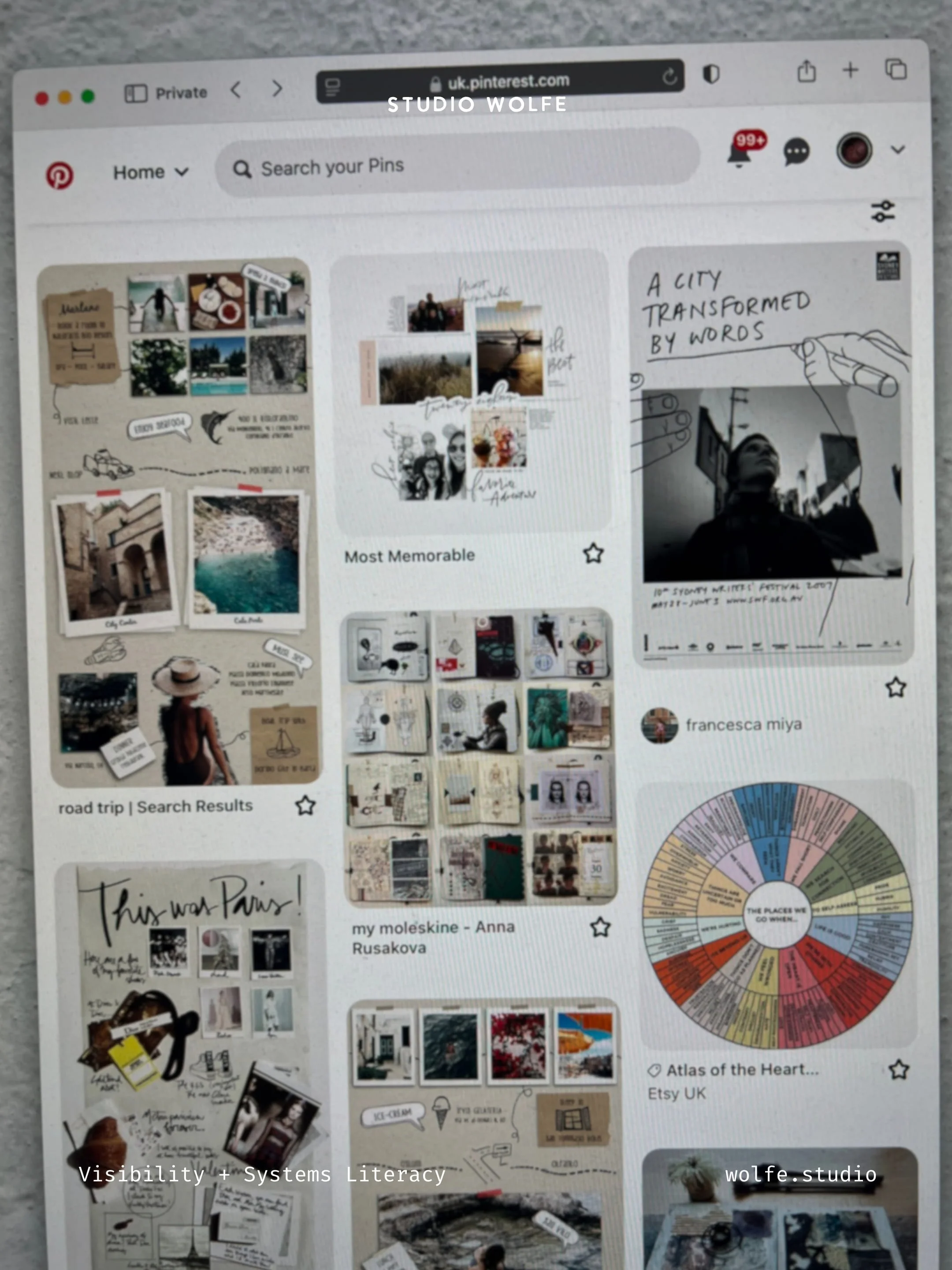
Some of those pathways are visual: visual discovery systems allow images, atmosphere, and aesthetic signals to become entry points into the wider creative ecosystem.
Mapping relationships between ideas allows the ecosystem to remain navigable even as it grows.
This approach transforms websites from collections of isolated pages into environments capable of holding multidimensional work.
06. Allow Architecture to Follow Reality
Creative work rarely fits neatly into predetermined categories.
When structure is imposed too early or too rigidly, the resulting system often feels constrained or fragmented.
Architecture functions best when it follows the natural structure of the work itself.
Observation, patience, and careful articulation allow systems to reveal their organising logic. Design then becomes a process of translating that logic into navigable form.
When these principles are respected, creative ecosystems tend to reveal their structure naturally rather than through forced organisation.
Architectural Synthesis
Thresholds are significant not because they mark beginnings, but because they reveal what has already been taking shape beneath the surface. Complex systems rarely move directly from dormancy into expansion. Instead, they pass through periods where internal coherence and environmental readiness gradually align before visible change begins.
Creative ecosystems follow the same pattern. Ideas incubate, integrate, and stabilise before they emerge into expression. When the moment of emergence arrives, the task is not to force movement but to recognise what is already beginning to unfold.
In a world where digital production becomes increasingly automated, the distinctive role of human creativity may lie less in constant output and more in recognising meaning, articulating authentic perspective, and shaping coherent systems. Architecture becomes the bridge between idea and expression, providing the structures through which emerging work can take form without losing its integrity.
When the architecture is ready, emergence no longer needs to be forced.
STUDIO WOLFE JOURNAL
This article sits within the Squarespace Architecture series — part of Studio Wolfe’s structural framework for designing coherent digital environments. Explore related posts within the Squarespace Architecture series or enquire about bespoke ecosystem support.